
 Dhruv Verma
May 15, 2026



Here's a question worth sitting with: your brand has a loyalty program. Your customers are enrolled. So why are most of them not actually using it?
This isn't a niche problem. Across the UAE, Saudi Arabia, India, and most other major markets, loyalty programs consistently struggle with the same gap - sign-ups are high, but active engagement falls far short of it.
Meanwhile, the share of consumers who consider themselves loyal to at least one brand has slid from 77% in 2022 to 69% in 2024 - a consistent decline across four consecutive years of SAP Emarsys research. And yet 91% of companies globally are running some form of loyalty initiative.
The math doesn't add up. Brands are investing heavily in loyalty. Customers are not reciprocating. Something has broken.
The problem isn't loyalty itself. It's how we've been doing it. For years, loyalty meant points - earn a point here, redeem a voucher there, a transactional exchange dressed up as a relationship. Customers saw through it quickly. And in a region like the Middle East and South Asia, where consumer expectations run high and competition for wallet share is fierce, a points card simply isn't enough.
What comes next is more interesting. AI isn't just improving loyalty programs. It's restructuring what they are. And the brands that understand this shift early - in Dubai, Riyadh, Bengaluru, and beyond - are the ones that will own customer relationships for the decade ahead.
Let's start with the scale of what's actually happening.
The global loyalty management industry stood at $15.2 billion in 2024 and is projected to reach $41.2 billion by 2032 - growing at a compound annual rate of 15.3%. The AI-specific segment of loyalty analytics is on an even steeper curve: from $1.82 billion today to $9.1 billion by 2033 at an 18.6% CAGR.
That's not an incremental growth. That's a structural transformation playing out in real time.
| $41.2B
Loyalty market projected by 2032 (Fortune Business Insights) |
18.6% CAGR of AI loyalty analytics (Growth Market Reports) |
Asia Pacific - which includes India, one of Thriwe's core markets - accounted for 31.3% of loyalty management revenue in 2025, making it the fastest-growing region globally. The Gulf markets are on a parallel trajectory. Saudi Arabia's Vision 2030 is driving significant investment in customer experience across retail, banking, and hospitality. The UAE, already a benchmark for service quality, keeps raising the bar further.
The window to differentiate on loyalty is open right now. In three to five years, AI-powered loyalty will be the default. The brands that move first won't just have better programs - they'll have deeper data, longer customer relationships, and an advantage that's very hard to replicate. The ones that wait will be retrofitting.
It's easy to say, 'AI is transforming loyalty' and leave it at that. Here are five concrete ways AI is already changing how loyalty programs work - not in theory, but in practice, right now.
Traditional loyalty programs slot customers into buckets: Gold, Silver, Platinum. The assumption is that everyone within a tier has the same preferences, spends the same way, wants the same rewards. Anyone who has actually worked in consumer marketing knows this is fiction.
AI makes mass personalization technically and economically feasible for the first time. By processing behavioral signals - purchase history, browsing patterns, redemption timing, app interactions - AI engines build a real-time picture of what each individual customer actually values.
The results are measurable. McKinsey's 2021 personalization study found that 78% of consumers are more likely to repurchase from brands that personalize their experience - a finding that has been replicated consistently across subsequent years.
In markets like the UAE and KSA, where premium positioning is a key competitive differentiator, personalization isn't a nice-to-have. It is the product.
One of the most underrated applications of AI in loyalty is not engagement — it's early warning. Most brands only notice a customer has left after a 90-day absence. By then, re-engagement costs are high, and success rates are low.
AI models trained on historical behaviour can identify disengagement signals weeks before they translate into actual churn — a drop in redemption frequency, a change in browsing patterns, a shift in spend category. Armed with that signal, brands can intervene with a targeted offer, a personalized message, or a proactive benefit before the customer has mentally checked out.
Gartner research indicates companies that deploy AI-driven retention strategies can reduce churn by up to 30% in specific sectors, and companies using AI for retention often see a 25–40% boost in customer lifetime value. The foundational economics are well-established: Bain & Company's research shows a 5% improvement in customer retention can boost profits by 25% to 95% — a range that holds across most industry verticals.
For banks, insurers, and telecoms across the Gulf and India — industries where acquisition is expensive and regulation tightens year on year — the ROI case for AI-powered churn prevention essentially writes itself.
Here's a problem nobody talks about enough: most customers don't know what benefits they have. They enrolled in a program, received a welcome email, and moved on. The benefits sit unclaimed. Engagement stays low. When renewal time comes, the customer sees no value.
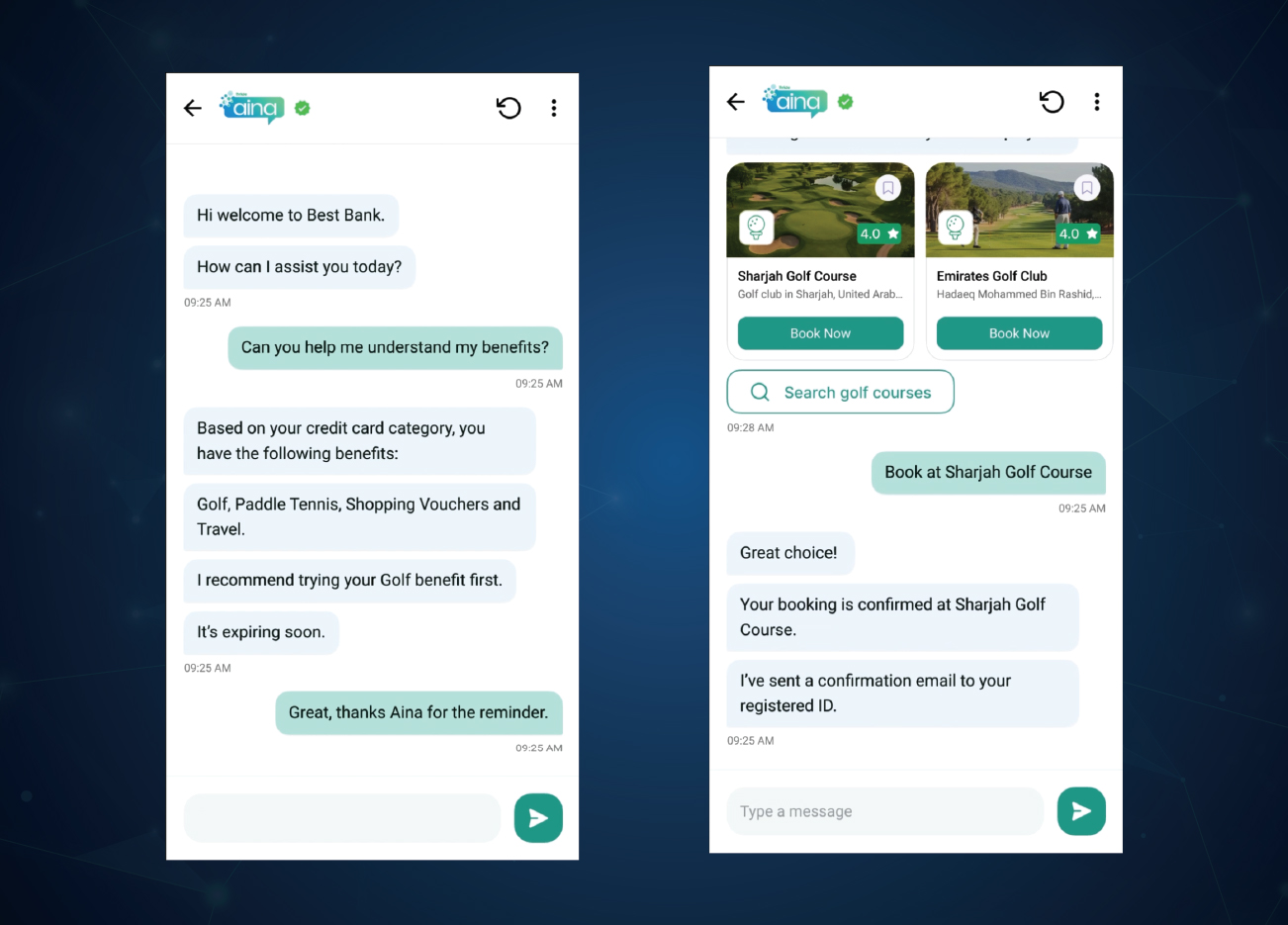
Conversational AI — purpose-built loyalty concierges solve this problem directly. Rather than asking customers to navigate a portal or call a helpline, AI agents surface relevant benefits proactively, in natural language, at the moment of intent. A customer asks about airport lounge access; the AI confirms eligibility, identifies the nearest lounges based on their location, and completes the redemption — in one conversation, in the customer's preferred language.
This is what Thriwe Aina, Thriwe's AI-powered benefits concierge, is built to do. Thriwe Aina understands complex emotions and intent, operates across multiple languages and regions, and is available 24/7 — making it particularly well-suited for the UAE and KSA's diverse, multilingual populations.
The trajectory is clear. Servion Global Solutions projected that AI would power 95% of all customer interactions by 2025. Gartner projects agentic AI will autonomously resolve 80% of common customer service issues by 2029 (Gartner, March 2025).
For brands, the operational impact of conversational AI is material: Aina delivers a significant reduction in human support costs while simultaneously improving resolution quality and response time. In high-volume markets like India and Saudi Arabia, that cost reduction is significant.
Static reward catalogues were fine when loyalty programs were afterthought. They're now a liability. A customer who earns points on Monday shouldn't have to wait for a monthly statement to understand their value. A customer in Dubai should see different reward options than a customer in Jeddah — not because they're different tiers, but because their context, preferences, and available redemption partners differ.
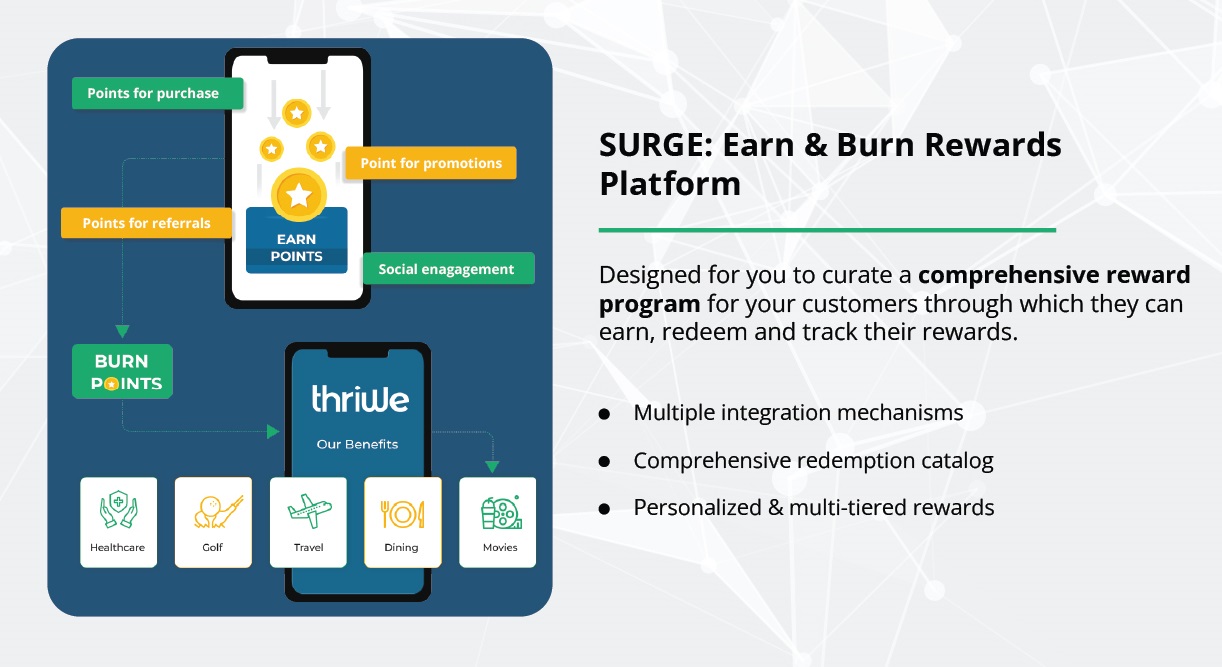
AI enables dynamic earn and burn logic: reward values that shift based on customer behavior, campaign priorities, and real-time inventory. The right offer reaches the right person at the right moment — not a bulk push that goes to everyone and resonates with few.
This is the philosophy behind Surge, Thriwe's earn and burn reward platform. Surge is built for flexibility — customizable across customer programs, employee reward schemes, and channel partner incentives, with the ability to minimize redemption complexity and maximize redemption rates.
One of the hidden costs of traditional loyalty programs is data fragmentation. A bank might know what a customer spends in-branch, but not what they do on the app. A retailer might track purchases but not browsing behavior. A hospitality brand might know check-in patterns but not dining preferences.
AI-powered loyalty platforms unify these signals. Every touchpoint — mobile, web, POS, in-app, WhatsApp — feeds into a single customer intelligence layer. The result is a continuously updated picture of the customer that drives smarter engagement across every channel.
In the Gulf region, this is especially important. Customers interact with brands across multiple touchpoints and expect consistency. A loyalty program that 'knows' them in one channel but forgets them in another creates friction — and in a competitive market, friction is churn waiting to happen.
"As we move closer to 2026, loyalty will be defined by intelligent, continuous engagement rather than point accumulation. Brands will increasingly rely on AI-powered personalised engines, including agentic recommendation capabilities, to deliver rewards, nudges and communication tailored to individual behaviour in real-time and across touchpoints. This evolution is driven by a more unified, data-led understanding of customer signals, allowing programs to move beyond rigid, rule-based models. Instead, this technology-led approach enables loyalty ecosystems to adapt dynamically to changing contexts and preferences. As a result, loyalty is emerging as a scalable, long-term driver of brand affinity, strengthening emotional connections by being meaningful, adaptive and aligned with end-to-end customer journeys. At the core of this shift are AI-powered, agentic recommendation engines that intelligently tailor rewards, nudges and communication based on individual behaviour"
- Dhruv Verma, CEO, Thriwe
AI loyalty transformation is not sector-agnostic. The industries feel it most acutely - and moving fastest - are banking and financial services, retail, and hospitality. These are also Thriwe's primary verticals.
Banks in the UAE and Saudi Arabia are in a uniquely complex position. Digital banking has lowered switching barriers significantly — a customer can open a new account in minutes. But regulatory requirements mean acquisition is expensive and often constrained. Loyalty has become increasingly a retention mechanism.
The problem is that traditional bank loyalty programs have a weak track record. Points on a credit card, a cashback percentage, a tier upgrade — these are commoditized. Every major bank offers something similar.
AI changes the conversation entirely. When a banking loyalty program can anticipate that a customer is planning a holiday based on their spending patterns, surface relevant travel insurance benefits proactively, and complete the conversion through a conversational interface that isn't a loyalty program; that's a relationship.
This is the use case Thriwe Aina was built for. Deployed within banking environments, Aina reduces support overhead while simultaneously increasing benefit discovery and redemption — turning dormant program members into active, engaged customers.
Retail loyalty in the UAE and KSA is at an inflection point. Mall-based retail, online marketplaces, and D2C brands are competing for the same wallet share. The gap between loyalty programs that work and those that don't work is widening.
The data is clear: companies with strong loyalty programs experience approximately 2.5x faster revenue growth than peers without them (electroiq.com, citing multiple academic sources, 2025). The top 5% of customers generate 35% of total retail revenue (Rivo VIP Tier Statistics, 2026). For any retailer, the economics of investing in keeping those customers — rather than constantly hunting new ones — are overwhelmingly in favour of retention.
AI-powered retail loyalty goes beyond discounts. It's about knowing when a customer's purchase cycle is about to peak, surfacing a relevant offer before they go to a competitor, and making the redemption experience frictionless enough that engagement becomes habitual.
Any honest conversation about AI in loyalty has to include the friction points. There are several worth naming directly.
None of these challenges are insurmountable. But they are real, and any vendor or consultant who dismisses them quickly is someone to be cautious of.
Thriwe was founded on the premise that loyalty should be genuinely valuable to the people it is meant to serve customers, employees, and channel partners alike. That principle has driven a product suite built for the AI era, not retrofitted into it.
Today, Thriwe has touchpoints across 120+ countries, serving 1 million+ customers through a network of 400,000+ partners, with over 3 million transactions processed. The platform serves enterprises across the UAE, Saudi Arabia, India, and wider MENA — and has been recognized as the Most Trusted Brand of India 2024–25 by Marksmen Daily.
Aina is Thriwe's AI-powered customer-facing concierge, designed specifically for loyalty and benefits delivery. It surfaces relevant benefits at the right moment, handles end-to-end redemption in natural language, resolves queries without routing to a human agent, and understands emotional context and intent across languages.
Surge is Thriwe's earn and burn platform — the engine that powers real-time reward logic across customer loyalty programs, employee incentive schemes, and channel partner programs. Reward structures, redemption catalogues, earn rules, and engagement triggers can all be configured to the specific requirements of each brand and market.
The philosophy behind Surge is that reward complexity is a loyalty killer. If a customer can't easily understand how to earn, what they can redeem, or when their points expire, they disengage. Surge is designed to make the reward experience feel effortless — which, paradoxically, requires significant sophistication on the back end.
Not every enterprise needs to build a loyalty program from scratch. Plug & Play offers a ready-made; curated benefits catalogue that brands can deploy rapidly. For businesses in growth mode, or those testing a new loyalty concept, Plug & Play provides enterprise-grade benefits delivery from day one.
If you're actively evaluating loyalty technology - whether building from scratch or upgrading an existing program - here's a practical checklist of what separates the platforms worth your time from those that will underdeliver.
Loyalty programs, on their own, aren't failing. Loyalty programs that haven't adapted to what customers actually expect — relevant, contextual, effortless, personal — are failing. The gap between those two categories is AI.
The economics are documented: retaining a customer costs 5 to 25 times less than acquiring a new one (Harvard Business Review). A 5% improvement in retention can boost profits by up to 95% (Bain & Company). Loyalty program members generate 12–18% more incremental revenue per year than non-members. These are not aspirational numbers; they are documented outcomes from real programs.
The question for business leaders in the UAE, Saudi Arabia, and India is not whether to invest in AI-powered loyalty. The question is how quickly they can move, and whether their chosen platform is built for the complexity of their markets.
AI loyalty is not a future state. The brands deploying it intelligently today — personalizing at scale, predicting churn before it happens, making benefits discoverable and easy to redeem — are building customer relationships that compound in value over time.
The brands that treat loyalty as a points ledger will spend the next decade wondering why their customers keep leaving.
Ready to build AI-powered loyalty your customers will actually use?
See how Aina and Surge can power your customer loyalty strategy across the GCC, Australia, SEA and India.
Book a Demo